
“We White People Are Prejudiced”
In June 1936, John J. Cunningham, a thirty-year-old blind Black man, attended a recreation night at the New York Association for the Blind (NYAB), also known as the “Lighthouse.” The event, held at NYAB’s Manhattan headquarters, left Cunningham deeply unsettled, as he discovered that he was in fact attending one of NYAB’s “jim-crow” nights (New York Amsterdam News 1936). Though NYAB claimed to offer services “regardless of race or creed,” he found that the night was designated exclusively for Black blind people – barred from joining the whites-only recreation events held the rest of the week (New York Association for the Blind 1937).
A week later, Cunningham returned to the NYAB headquarters, this time “accompanied by a few friends” (Meldon 1936). Cunningham, who had spent the past week investigating NYAB racial practices, now leveled his charges at Edward M. Dowling, the NYAB Director of Public Welfare: Black blind people were denied access to the swimming pool and boarding house, excluded from employment, and sent to separate summer camps; and NYAB’s social and recreational clubs and activities were racially segregated.
“It amounts to downright segregation,” Cunningham declaimed, “and we don’t intend to have racial discrimination added to our already miserable lot [of blindness]. We are going to fight it – and wipe it out. We won’t be Jim Crowed any longer!” (Meldon 1936)
To these accusations Dowling reportedly replied, “We white people are prejudiced. I do not favor whites and Negroes being together in such things as swimming and dancing. Negroes like to be together. The whites would leave if we permitted Negroes full freedom. No, the white blind have not complained, but such things are not for them to decide, but for the Board of Directors” (New York Age 1936).
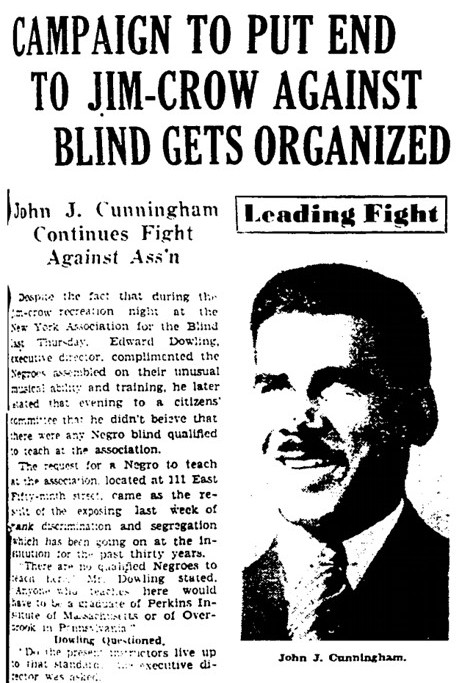
Figure 1. John J. Cunningham, inset, pictured here alongside an article published by the prominent Harlem-based Black newspaper, the New York Amsterdam News, touting the campaign against racial segregation at the New York Association for the Blind. (“Campaign to Put End to Jim-Crow Against Blind Gets Organized,” New York Amsterdam News, 8 August 1936, p. 11. ProQuest Historical Newspapers. Property of the New York Amsterdam News. Used herein under principles of fair use for scholarly purposes only.)
Black Disability Politics
It tends to be forgotten, but the era of the New Deal and World War II was marked by ubiquitous racial segregation, North and South (Purnell, Theoharis, and Woodard 2019). Even the US Army, which fought a putative war to defend democracy against fascism, remained racially segregated until years after the war’s end. This national regime of Jim Crow segregation was codified in the “separate but equal” doctrine, pursuant to the Supreme Court’s 1896 Plessy v. Ferguson ruling, which was not overturned until 1954 in Brown v. Board of Education (Luxenberg 2019). But long before 1954, in spaces both central and peripheral, there were individuals, activists, and organizations struggling against the scourge of segregation. They compose part of what historian Jacquelyn Dowd Hall (2005) has called the “long civil rights movement,” linking 1930s activism with the broader struggles that culminated in the 1960s. Similarly, one can speak of a long disability rights (or justice) movement, insofar as self-conscious political organizing on the part of disabled people can be situated in the 1930s-40s period (Longmore and Goldberger 2000; Jennings 2007), well before its supposed ‘modern’ advent in the 1970s (Fleischer and Zames 2011).
There is also a specific historical salience to the practice of racial segregation as it pertains to disability in general, and blindness in particular. Consider, for example, the following article published in 1938 in Outlook for the Blind, a magazine affiliated with the American Foundation for the Blind, surveying the activities of a program for the blind in Topeka, Kansas.
Two training-centers are maintained where instruction in handcrafts and braille is offered. One of the groups is made up of colored workers and is housed in a long-established community center for the colored where the opportunity for integration into additional community activities with sighted persons of the natural social group is offered. The thought in this instance is that race is a more satisfactory basis for choosing associates than the existence of a handicap [emphasis added]. (Hayes 1938, 47)
In other words, even as the field of disability services began to question segregation based on impairment, it continued to naturalize racial separation. Indeed, the insistence upon racial segregation in the case of those who literally could not ‘see’ race (insofar as race operates largely as a visible marker within the US context), raises questions about the social construction of race itself, including apropos to contemporary notions of “post-racial” “color-blindness” (Doane 2017; Fields and Fields 2012).
Finally, insofar as figures such as John Cunningham were compelled to navigate and resist such interconnected regimes of racial and disability identity and oppression, this can also be understood as a form of “black disability politics,” as Sami Schalk (2022) has phrased it; history at the intersection of Blackness and disability. As an emerging academic field (though long existing in practice), Black Disability Studies is an underappreciated but vital lens through which to gain greater insight into such multiplex historical phenomena. The story of John Cunningham is just one example of how “black disability politics” animated the lives of Black disabled people and their struggles for social emancipation.
“A Committee of Colored People”
Stymied by the intransigence of Edward Dowling, John Cunningham and his comrades organized a “committee of colored people,” based in Harlem, to publicly challenge NYAB’s practices (Atlanta Daily World 1936). The committee encompassed several of the leading Black organizations and political individuals in New York City: Juanita Jackson of the National Association for the Advancement of Colored People (NAACP); George Murphy, Jr., of the NAACP and the National Negro Congress; Thurgood Marshall of the NAACP; and Ben Davis, Jr., Daily Worker writer and prominent Communist Party member. Their campaign was also covered favorably by the leading Black newspapers of New York City and beyond, such as the New York Amsterdam News, New York Age, Atlanta Daily World, and Pittsburgh Courier.
Over a period of months and ultimately years, Cunningham and the committee struggled mightily against the inertial resistance of the NYAB Board of Directors. What made this particularly galling was that NYAB was not just any blind service organization; it was an eminently prestigious philanthropic institution, and the largest of its kind in the U.S. The Board of Directors and Trustees of NYAB represented a congeries of the political, economic, and cultural elite of New York City: the editor-in-chief of the New York Times, sitting Supreme Court and federal judges, and Wall Street barons (Davis 1937; New York Association for the Blind 1937). Challenging NYAB was, in effect, challenging the city’s ruling class.
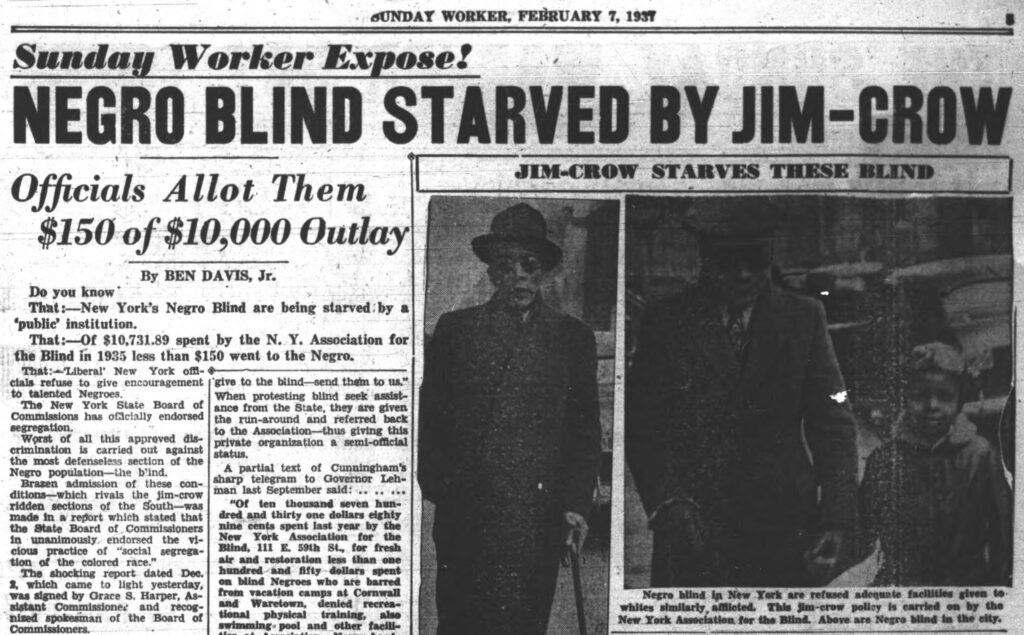
Figure 2. Featuring pictures of a sample of “Negro blind in the city,” this full-page exposé by the Daily Worker writer, prominent Communist Party member, and future City Councilmember, Ben Davis, Jr., communicates the broader social import of the struggle against racism at the New York Association for the Blind. (“Negro Blind Starved by Jim-Crow,” Daily Worker, 7 February 1937, p.5. ProQuest Historical Newspapers. Property of Long View Publishing Company. Used herein under principles of fair use for scholarly purposes only.)
Race and Class at the Lighthouse
Shortly after the onset of Cunningham’s public campaign, in April 1937, a separate but intersecting struggle erupted at the Lighthouse. Nearly one hundred blind workers at NYAB’s broom and mop workshop went on strike for union recognition, and better wages and working conditions (New York Herald Tribune 1937). Curiously, there appears to be no explicit archival link between the strike and the anti-racist campaign, which is surprising (if not a tactical missed opportunity) given the extent of potential political overlap. Cunningham himself had remarked, “The blind, white and black, are exploited by the Lighthouse. But the colored are exploited and discriminated against.” Matthew Butler, another blind Black person supporting the anti-racist campaign, similarly told the New York Age, “All the workers, both black and white, are exploited at the Lighthouse, but the conditions for Negroes are unbearable” (1936).
“Separate But Equal”
Throughout their campaign, Cunningham and the committee ran aground on the entrenched embrace by the hegemonic classes of New York City of the “separate but equal” doctrine. In early 1937, under public pressure, Governor Herbert Lehman directed the State Board of Commissioners to investigate NYAB. However, the Board concluded that racial “segregation represents a general problem of the colored race and [we] do not feel that the policy of the Lighthouse in this regard is open to criticism” (Davis 1937).
Between 1938-39 the struggle against NYAB dramatically ebbed, only to return during the years 1940-42, when Cunningham reinitiated activity alongside the NAACP’s Thurgood Marshall. Cunningham and Marshall sent inquiries to Eleanor Roosevelt and the New York City chapter of the American Civil Liberties Union, respectively, about NYAB’s continuing segregation. Roosevelt replied with a terse dismissal, stating that NYAB seems to be “advancing satisfactorily.” The ACLU demurred that although NYAB activities were indeed racially segregated, there was no racial “discrimination,” because “the Negroes are afforded equal opportunities” or otherwise “have equally limited equipment and facilities” as the Whites (“Racial Discrimination,” NAACP Papers). In other words, separate but equal.
Historical Genealogies
Although Cunningham’s immediate campaign did not achieve full desegregation at NYAB, it was nonetheless significant on at least three counts. First, it was such campaigns as these that provided Thurgood Marshall – and the nation – with rehearsals for the eventual overthrow of “separate but equal,” which Marshall would finally secure with his winning arguments in the Brown v. Board decision, viz. that racial separation is inherently unequal and discriminatory. Second, the NYAB struggle forms a part of that molecular process of history, often occluded unceremoniously by later apotheoses, by which social relations cumulatively undergo microscopic changes prior to manifesting as macroscopic eruptions, or ‘turning points,’ of history. Finally, as mentioned above, this history constitutes an important part of the genealogies of the “long civil rights movement,” long disability justice movement, and tradition of “black disability politics,” each of which contain enduring import apropos to both epistemology and activist praxis.
References
Atlanta Daily World. 1936. “Seek Rights for Blind.” 11 August.
Davis, Ben, Jr. 1937. “Negro Blind Starved by Jim-Crow.” Daily Worker, 7 February.
Doane, Ashley. 2017. “Beyond Color-blindness: (Re) Theorizing Racial Ideology.” Sociological Perspectives 60 (5): 975-991. https://doi.org/10.1177/0731121417719697.
Fields, Karen Elise, and Barbara Jeanne Fields. 2012. Racecraft: The Soul of Inequality in American Life. London: Verso.
Fleischer, Doris Zames, and Frieda Zames. 2011. The Disability Rights Movement: From Charity to Confrontation. Temple University Press.
Jennings, Audra. 2007. “‘The Greatest Numbers … Will Be Wage Earners’: Organized Labor and Disability Activism, 1945-1953.” Labor 4 (4): 55–82. https://doi.org/10.1215/15476715-2007-034.
Hall, Jacquelyn Dowd. 2005. “The Long Civil Rights Movement and the Political Uses of the Past.” Journal of American History 91 (4): 1233–63. https://doi.org/10.2307/3660172.
Hayes, Harry. 1938. “The Topeka Program for the Blind.” Outlook for the Blind 32 (2): 47-48. https://archive.org/details/outlookforblind32unse/page/47/mode/1up.
Longmore, Paul K., and David Goldberger. 2000. “The League of the Physically Handicapped and the Great Depression: A Case Study in the New Disability History.” Journal of American History 87 (3): 888–922. https://doi.org/10.2307/2675276.
Luxenberg, Steve. 2019. Separate: The Story of Plessy v. Ferguson, and America’s Journey From Slavery to Segregation. eBook. New York: W. W. Norton & Company.
Meldon, John. 1936. “Negro Bares Jim-Crow Rules at Association for the Blind.” Daily Worker, 30 July.
New York Age. 1936. “Committees Formed to Help Blind.” 15 August.
New York Amsterdam News. 1936. “Campaign to Put End to Jim-Crow Against Blind Gets Organized.” 8 August.
New York Association for the Blind. 1937. Thirty-first Report for the Year Ending October 31, 1937. New York Public Library.
New York Herald Tribune. 1937. “Blind Aid Blind With Sympathy Strike.” 9 April.
Purnell, Brian, Jeanne Theoharis, and Komozi Woodard. 2019. The Strange Careers of the Jim Crow North: Segregation and Struggle Outside of the South. New York University Press.
“Racial Discrimination by New York Association for the Blind.” NAACP Papers, Part 18: Special Subjects, 1940-1955. Library of Congress.
Schalk, Sami. 2022. Black Disability Politics. Durham: Duke University Press.
Keith Rosenthal is a PhD candidate in History at the City University of New York, Graduate Center. His writings on disability, capitalism, and labor have been published in Disability Studies Quarterly, Jacobin, Monthly Review, Spectre, and New Politics. He is the editor of Capitalism & Disability: Selected Writings by Marta Russell, published by Haymarket Books in 2019. See http://keithrosenthal.wordpress.com for more.

One thought on “John Cunningham and the Struggle Against ‘Separate-But-Equal’ Colored-Blindness in Depression-Era New York City”