
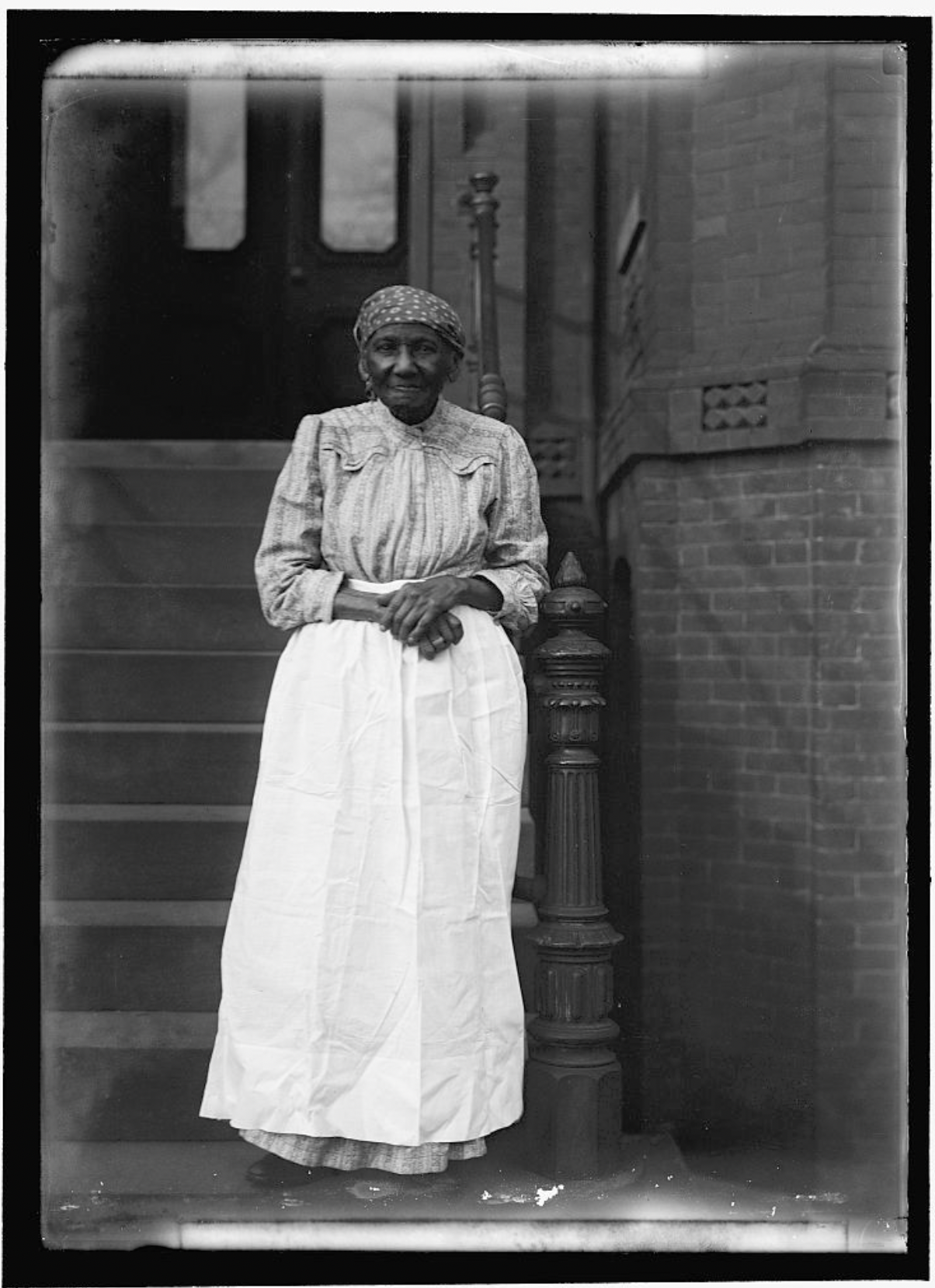
Although no images of Black women residents are extant, investigating census and public records may reveal more about their lives before their time in the Home. (Unidentified African American Woman, c. 1911-1917, Harris & Ewing photographer, Courtesy of the Library of Congress).
Amelia Cubbins entered Boston’s Home for Aged Colored Women in 1860, its first year of operation. Born in Baltimore, she had spent the majority of her life enslaved. Now aged seventy, Amelia was widowed, infirm, and destitute. Her arrival and residency in Boston for the previous nine years had occurred due to the labor and advocacy of her daughter. Charlotte, also born into slavery, purchased the freedom of her mother and facilitated her arrival in the city with the help of friends in 1851. Their story was one of hardship, trauma, family separation, and the collective power of community action. By 1860, unable to support herself, relying on the charity of others, and needing more care than her daughter could provide, Amelia turned to the Home for protection and support (Home for Aged Colored Women, Admissions Records).
In the mid to late nineteenth century, the responsibility of caring for dependent citizens, including older adults, shifted from community-supported Overseers of the Poor to private institutions. In the city of Boston, a number of institutions emerged between 1850 and 1880. The majority, however, implicitly or explicitly excluded African Americans from accessing aid (MacCarthy 1993, 55-56). For example, the founders of Boston’s Home for Aged Women, established in 1850, believed it should only serve “American born women” due to the “great influx of foreigners among us,” revealing a concerted attempt to determine ‘worthiness’ of aid based on background, race, ethnicity, and community (Third Annual Report, Home for Aged Women, 1853). In addition, the requirement that women be residents of Boston for ten years preceding their application to the Home denied relief to Black refugees or former fugitives from slavery (Home for Aged Women Annual Reports, 1850 & 1852).
The founders of Boston’s Home for Aged Colored Women sought to rectify the exclusion of Black women from charitable communities of care. White benefactors Rev. James Freeman Clarke and his mother, Rebecca Parker Clarke, initiated the process in concert with African American minister Rev. Leonard Grimes. Grimes, a long contributor to the Underground Railroad and pastor of Boston’s Twelfth Baptist Church since 1848, was the link between the institution and Boston’s broader free Black community. Although only Rev. Leonard Grimes appears on committees, his wife, Octavia Grimes, also heavily contributed to the Home. Octavia helped found the Colored Ladies’ Relief Society, the Sewing Society, the Fugitives’ Aid Society, and the Colored Ladies’ Sanitary Commission of Boston during the Civil War. She labored with her husband to survey their community to identify needs and visit inmates.
Community institutions of care created physical spaces to shelter those at risk and served a political function to heal, reform, and nurture vulnerable communities. The exclusion of Black women from these spaces constituted another vector of harm directed toward communities of color. In contrast, Boston’s Home for Aged Colored Women was a refuge for older women of color. Already working on the economic margins, agedness and increasing physical infirmity forced Black women to the lowest level of wage earning. Some experienced “sickness, infirmities of age, [and] querulous tempers,” while others were “crippled with rheumatism … lameness, spine complaint, and various weaknesses” that prevented them from earning a living. Once admitted to the Home, some contributed to household tasks like washing, sewing, or sweeping, but most could manage only “the lightest of work” (Sixth Annual Report, Home for Aged Colored Women, 1865). Disability, infirmity, and agedness informed the collective experience of residents from fifty to their mid-nineties.
Examining one of the earliest residents of the Home, Amelia Cubbins, provides additional scope for thought. Putting aside a tumultuous journey from slavery to freedom, the records of the Home offer one additional surprising fact – her daughter Charlotte was also admitted to the Home that day. Although only twenty-eight, significantly younger than the average resident of the institution, Admissions Committee members deemed Charlotte to “[have] been an idiot since birth” and was thus “admitted with her mother who could not leave her” (Home for Aged Colored Women, Admissions Records). The same Charlotte who had one point traveled (whether independently or dependently, forcibly or voluntarily) from Baltimore to Boston and aided in the manumission of her mother was deemed incapable of caring for herself. No more is said about the nature of her disability, nor do the Cubbins appear anywhere beyond their admission record.
Exploring the history of the Home and its residents raises intriguing questions about the complicated intersections between race, gender, age, disability, and class. Under what circumstances were Amelia and Charlotte separated in Baltimore? What was the nature of her disability that reduced her to a state of ‘idiocy’ and prevented her from supporting her mother in freedom, but nonetheless allowed her to advocate for and actualize her mother’s manumission? Is it possible Charlotte exaggerated her infirmity in order to remain with her mother, or did she suffer from sporadic ailments that temporarily disabled her? An alternative reading suggests Amelia – not Charlotte – insisted her daughter accompany her. How extensive was the role of Boston’s free Black community in supporting the Cubbins in their bid for freedom and as residents in the Home? Their residence in the Home for Aged Colored Women sheds light on the intertwined legacies of slavery, gender, and disability in nineteenth-century America. It provides a glimpse into the myriad stories of impoverished women of color struggling to carve out space for themselves in the Civil War era.
Central to this exploration is understanding the fluid definitions of ‘aged’ or ‘elderly’ in this period. In addition, the disability and infirmity that shaped the experiences of elderly Black women inmates were crucially linked to enslavement, fugitivity, and lifetimes of debilitating labor. Old age itself can be inherently disabling, but residents experienced the multiplied effects of decades of debilitating labor, the trauma of enslavement, the tragedy of losing loved ones, spouses, and children, and the burden of vulnerability. Older women of color performed various characteristics of deservedness, including emphasizing both disability and ability, to access care. Exploring the complicated intersections between race, gender, age, disability, and class about the Home barely scratches the surface. Still, it is an essential step toward reclaiming the agency, resistance, and selfhood of Boston’s older women of color.
References
Administrative Records, Admissions Committee Records, 1860-1875. Home for Aged Colored Women Records, 1843-1949, Massachusetts Historical Society.
Third Annual Report of the Association for the Relief of Aged Indigent Females. John Wilson & Son, 1853.
Association for the Relief of Aged Indigent Females. Eastburn’s Press, 1850.
Second Annual Report of the Association for the Relief of Aged Indigent Females. John Wilson & Son, 1852.
MacCarthy, Esther. 1993. “The Home for Aged Colored Women, 1861-1944.” Historical Journal of Massachusetts 21 (1): 55-73.
Sixth Annual Report of the Board of Managers of the Home for Aged Colored Women. Prentiss & Deland, 1866.
Seventh Annual Report of the Directors of the Home for Aged Colored Women. Prentiss & Deland, 1867.
Kathryn Angelica is an Assistant Professor of United States History at Purdue University, Fort Wayne. Her book manuscript in progress, Their Mighty Influence: Nineteenth-Century Black and White Women’s Activist Networks, explores the ways social movements intersected and intervened to reveal the impact, tensions, and complexity of generational change.
