
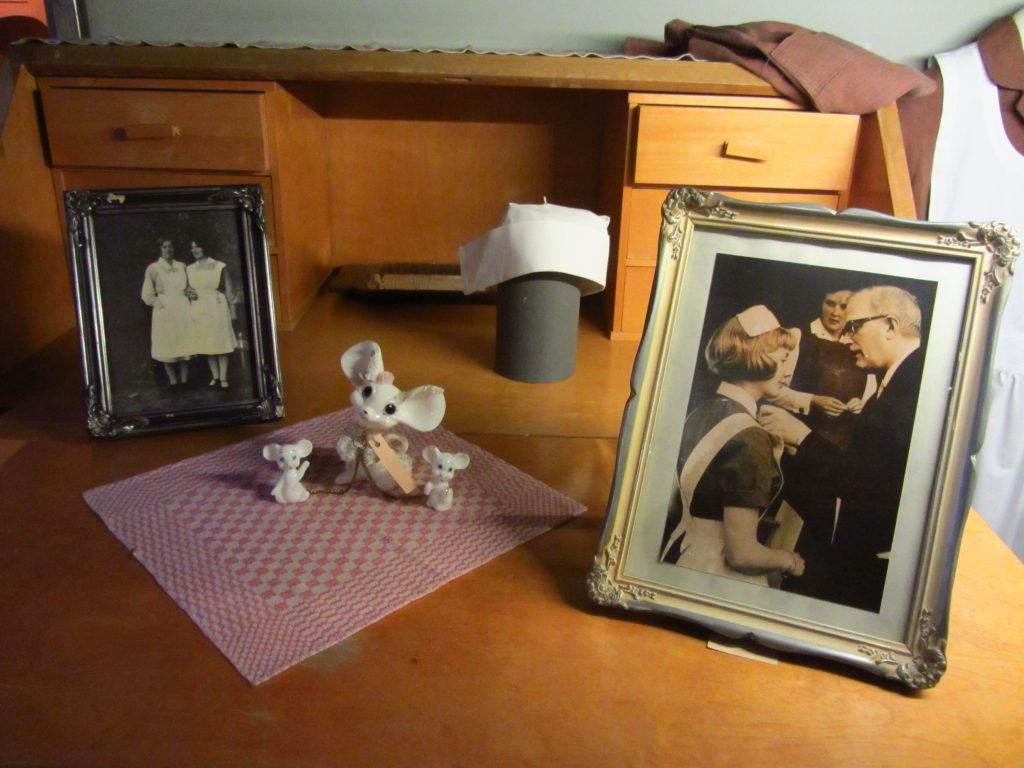
On the left, we can see a compilation of cozy furniture, little porcelain figurines, and photos of laughing nurses; on the right, a rusty bedstead beneath a picture of a sterile, monotonous dormitory. These artifacts, collected from Stretered, a former institution for persons with intellectual disabilities in western Sweden, are set up to irritate the visitors – the stark contrasts between the daily lives of nursing staff and residents are jarring. Even more striking is how these objects disrupt the flow of other segments of the exhibition Öppna magasinet (Open the Magazine) at Mölndal City Museum. Surrounded by homely and nostalgic clutter portraying mid-20th century everyday life, they feel conspicuously out of place, confronting visitors with the uncomfortable history of segregated institutional care.
In this blog post, I will explore some of the possibilities and limitations of object-based museum exhibitions on disability, using Öppna magasinet as an example. How effectively can objects convey sensitive historical content and ambiguities, such as attitudes towards disability and institutionalization? And how should museums approach eugenic practices like sterilizations, which left behind few tangible traces?

Pictured (left): Objects belonging to the nursing staff at Stretered institution (1895-1990) in the exhibition Öppna magasinet at Mölndal City Museum in Sweden. Photo: Anna Derksen.

Pictured (right): The old metal bed wedged in between depository shelves was one of many in the austere dormitories at Stretered, as the old photograph in the background shows. Exhibition Öppna magasinet, Mölndal City Museum. Photo: Anna Derksen.
“You and me, us and them”
Objects may be neutral in themselves, but their public display is anything but arbitrary: curators select and arrange, providing context and narrative frames, while visitors imbue meaning through personal memories, affects, and associations (Evans, Nicolaisen, Tougaard and Achiam 2020). This dynamic is at the heart of Öppna magasinet, which functions as both exhibition and museum depot. With over 10,000 artifacts organized by themes and provenance, Öppna magasinet traces the cultural history of Mölndal, an industrial hub since the late 19th century characterized by workers’ homes and housing estates that still echo the community-oriented modernism of the 1950s and 1960s. Mostly without information panels or descriptions – visitors are directed to look up further information online – the exhibited objects encourage exploration of both the local past and personal memories. With a fair dose of nostalgia, the furniture, tools and toys add to the broader narrative of the Swedish welfare society, the ‘People’s Home,’ and its promises of welfare, equality, and security.
The Stretered display starkly contrasts with this warm atmosphere. Under the heading You and Me, Us and Them, one of the exhibition’s rare interpretive text panels describes Stretered’s role in perpetuating social exclusion through institutional care. Founded in 1895, this care home and boarding school for persons with intellectual disabilities became one of Sweden’s largest institutions of its kind, eventually accommodating around 700 residents in dormitories, school facilities, and workshops until its closure in the early 1990s. What stands out in the Stretered display is the disconnect between its objects and the blunt text panel that addresses a defining aspect of disability care during this period: obligatory sterilizations. The panel states plainly, “The pupils were sterilized after their confirmation. Only then was it possible to eventually leave the institution.” Yet, no objects here directly reference or represent this invasive practice.
Instead, the display presents furniture, tableware, teaching materials, and medical equipment, along with photos and administrative reports – items that convey institutional order and caregiving but fail to address deeper implications of control and segregation. The discrepancy between text and objects indicates a curated narrative of institutional life that emphasizes the staff’s activities and routines over residents’ experiences. As we can see from photographs, while common areas were designed to mimic a ‘home-like’ environment with colorful curtains, tablecloths, and decor, the residents themselves were typically left with little more than a nightstand to store personal belongings – if they had any at all, as their absence from the exhibition suggests.
Visitors are invited to explore institutional reports from the 1940s and 1950s, which detail the day-to-day operations of Stretered. Medical appointments, telephone expenses, visits by the local Social Democratic Women’s Club, or film screenings are all catalogued in meticulous and exhausting detail but no records reflect the personal impact of life within these walls – not even a life-defining intervention like a sterilization. Why, then, the prominent mention of them in the text panel?

Pictured: Stretered, here depicted on a postcard from the late 1940s, was one of Sweden’s largest institutions for persons with intellectual disabilities with a focus on education and vocational training. Source: Mölndal City Museum, CC BY-SA, via digitaltmuseum.se.
“Only then was it possible to leave the institution”
The answer may lie in the expectations and prior knowledge that visitors in Sweden may bring to an exhibition on this topic. By highlighting sterilizations in the text panel, the exhibition taps into broader societal reckonings with Sweden’s eugenic past. Indeed, eugenic practices such as sterilizations have been present in the Swedish public consciousness at least since the so-called ‘sterilization debate’ of the late 1990s, when newspapers, historians, and politicians critically discussed the fact that Swedish legislation on sterilization had provided the ground for involuntary and coercive sterilization practices until as late as the 1970s.
Institutions like Stretered played a key role in implementing such measures rooted in a certain ‘welfare logic,’ where societal well-being was prioritized over individual rights (Broberg and Roll-Hansen 1996; Runcis 1998; Tydén 2002; Björkman and Widmalm 2010). The public debates of the 1990s spurred extensive historical and legal inquiries, leading to the country’s first official compensation scheme for victims (Arvidsson 2016). These debates also significantly tarnished the narrative of the community-focused ‘People’s Home,’ which Öppna magasinet seeks to evoke. For marginalized groups like persons with disabilities, it became clear that the ideals of equality and security were selectively applied.


Pictured (left): An information panel with basic historical facts about Stretered and Swedish sterilisation legislation. Exhibition Öppna magasinet, Mölndal City Museum. Photo: Anna Derksen.
Pictured (right): Stretered’s annual reports, here from the 1940s and 1950s, provided detailed listings of annual expenditures, learning and leisure activities, or illnesses and doctor visits – but omit any reference to sterilisations. Exhibition Öppna magasinet, Mölndal City Museum. Photo: Anna Derksen.
The text panel thus functions as a corrective to the material display, compensating for the absence of objects that directly address sterilization. But the gaps left by official records are also made up for in other ways. A small notebook titled Siri’s Story, Stretered 1915-1923 offers one of the few personal glimpses into life at Stretered. Placed on a nightstand and inviting visitors to read it, its entries replicate a resident’s impressions and thoughts in the form of a diary or memoir, yet again make no mention of sterilization. This is not very surprising, though, given that it covers a period before the first Swedish sterilization law was enacted in 1935. Whether Siri’s narrative is authentic or fictional remains unclear, but as the only personal voice of a Stretered resident it occupies an important place among the artifacts, underscoring the absence of personal voices in institutional records. Yet, its unclear origins also raise questions about the ethics of fictionalizing lived experiences. Siri’s entries oscillate between joy at learning arithmetic – now she could manage her own money! – and sadness at not being discharged after her confirmation:
“It wasn’t possible, they wanted me to work here. My father came to see me once a month. I wanted to get out of here. I was tired of being at Stretered back then. Longing for home.”
Does the display intend for visitors to draw a connection between Siri’s confirmation and the sterilizations mentioned in the text panel – two practices that were typically carried out together and were prerequisites for leaving the institution? The exhibition does not provide a clear answer. However, a look at local newspapers (which are not a part of the exhibition) reveals that sterilizations had indeed been quite common at Stretered, and that these practices were known beyond institutional borders. In 1972, for example, an article in the tabloid Expressen reported about a study on sex education in Stretered with the outraged headline, “One in three don’t know how to make children!” (Henning 1972). According to the study’s “shocking results,” most residents were uninformed about reproductive processes or STDs, while others thought that sterilization was a standard contraception method. But while the article decried this lack of knowledge, particularly given the fact that Stretered’s educational curriculum had enough capacities for subjects like “Floral Studies, English, and Beauty Care,” it did not remark on the sterilizations and their apparent systemic nature.

Pictured: Through Siri’s Story, displayed on a nightstand, visitors are given a personal insight into institutional life in Stretered at the beginning of the 20th century. Exhibition Öppna magasinet, Mölndal City Museum. Photo: Anna Derksen.
“Are you out of your mind?”
When Stretered ceased operations in 1990, its collection was transferred to Mölndal City Museum. While Öppna magasinet emphasizes objects to evoke exploration and nostalgia, the traveling exhibition Är du inte riktigt klok? (Are You Out of Your Mind?) that opened already in the same year Stretered closed down and used partly the same objects as the current display, opted for immersive storytelling to confront visitors with the lived experiences of persons with intellectual disabilities from their perspective. A striking feature was the ‘lottery’ at the entrance that fatefully labeled visitors as “feeble-minded,” “crazy,” “fit for the asylum,” or “normal.” This set the stage for a disorienting journey through a series of stations, likened to an “institutional merry-go-round,” that both explained and mocked the procedural steps of being admitted into psychiatric or disability care.
Är du inte riktigt klok? also went deeper on other issues: More than just hinting at sterilization, the exhibition included quotes and visuals representing how eugenics impacted residents explicitly, portraying sterilization as part of “the rough way the intellectually disabled were pushed over the threshold of adulthood” (Karlsson 1993). The exhibition deliberately wanted to shake things up, as curator Catarina Ingemarsson told Göteborgs-Posten in 1993:
“Only 40-50 years have passed since the current Romanian horror stories of care homes and institutions for the disabled were a reality in Sweden. But people don’t seem to think about that. What struck me most when I worked on the exhibition is that there are still so many prejudices against persons with intellectual disabilities.” (Karlsson 1993)

Pictured (left): “The Theatre of Prejudice”: Picture from a 1990 exhibition that critically reflected Stretered’s history and its approaches to intellectual disability. Source: Mölndal City Museum, CC BY-SA, via digitaltmuseum.se.

Pictured (right): With Rolf, Klas and Inga-Lill, the 1990 exhibition also put a focus on the biographies and personal experiences of former residents. Source: Mölndal City Museum, CC BY-SA, via digitaltmuseum.se.
While Är du inte riktigt klok? explicitly critiqued institutional practices and societal attitudes, it also foregrounded the perceptions of former residents. This personal approach was further expanded years later by the integrative theatre group Glädje in their 2016 play Stretarna (The People from Stretered). Drawing on interviews with former residents and staff, as well as archival materials, Stretarna offered a platform for personal narratives to take center stage. As theatre director Linda Faith noted: “You tell it as your own history […]; there were times when persons with disabilities were not expected to accomplish anything, but when you do this in front of the audience, it becomes real” (Hansson 2016).
What can we take away from this brief exploration of exhibiting histories of eugenics and sterilization? The Stretered collection demonstrates that while object-based exhibitions like Öppna magasinet provide a valuable starting point for deeper reflection and research, they risk leaving gaps in conveying the complexity of lived experiences when relying solely on artifacts, requiring visitors to infer or imagine personal narratives. The evocative power of objects, however, does not need to be balanced with explanatory text alone. Approaches that emphasize personal experiences – whether through immersive exhibitions like Är du inte riktigt klok? or performative storytelling like Stretarna – may not only engage audiences more effectively. They may also convey a more nuanced understanding that static objects alone cannot fully capture.
References
Arvidsson, Malin. 2016. Att ersätta det oersättliga: statlig gottgörelse för ofrivillig sterilisering och vanvård av omhändertagna barn. Örebro: Örebro University.
Björkman, Maria, and Sven Widmalm. 2010. “Selling Eugenics: The Case of Sweden.” Notes & Records 64 (4): 379–400.
Broberg, Gunnar, and Nils Roll-Hansen, eds. 1996. Eugenics and the Welfare State. Sterilization Policy in Denmark, Sweden, Norway, and Finland. East Lansing: Michigan State University Press.
Evans, Henry J., Line B. Nicolaisen, Sara Tougaard and Marianne Achiam. 2020. “Museums beyond Neutrality.” Nordic Museology 2: 19–25.
Hansson, Karina. 2016. “Stretarna berättar en skamlig historia.” Göteborgs-Posten, November 2, 2016.
Henning, Christina. 1972. “Var tredje vet inte hur man får barn! Sexutredning på vårdhem gav skrämmande resultat.” Expressen, April 15, 1972.
Karlsson, Ebon. 1993. “Gripande människoöden. Borås museum visar handikappades historia.” Göteborgs-Posten, January 16, 1993.
Runcis, Maija. 1998. Steriliseringar i folkhemmet. Stockholm: Ordfront.
Tydén, Mattias. 2002. Från politik til praktik. De svenska steriliseringslagarna. Stockholm: Almquist och Wiksell.

Anna Derksen is a lecturer at the University of Greifswald in Germany where she specializes in 20th century Nordic and Scandinavian history, disability and eugenics, as well as experiences of welfare and social policy interventions. She has studied at Friedrich Schiller University, Jena (Germany), the University of Gothenburg in Sweden, and Leiden University in the Netherlands.
